

Dr. Nancy L. Segal
Boston: Academic Studies Press (2023)
Review by Claudia Morris
Department of Psychology, California State University, Fullerton
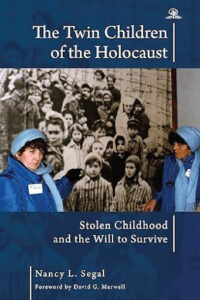
The Twin Children of the Holocaust: A Book Review
I would like to start this book review by proposing an unconventional way of performing such a task. I believe that by simply reviewing the book, the reviewer does not give the author enough information to deeply understand the context of the review. Indeed, there are some online book reviews for The Twin Children of the Holocaust: Stolen Childhood and the Will to Survive; some reviews discuss the readers' emotions while reading the book, while others fail to go into such depth.
I believe that adding a narration of the real-time impact of inner thoughts and feelings, instead of just the after-reading perspective, is better-suited to a review of a book that evokes so many emotions. The decision to choose this atypical path came to me after reading page three: Dedication. I anticipated that this book would be particularly sorrowful because it relates to the Holocaust, trauma, and the loss of countless lives by torture. However, I felt a deeper-than-expected impact almost immediately. Three words … “We Remember You”, referencing the twins who had passed, instantly brought tears to my eyes. I expected to find many moments of incredible sadness and anger counterbalanced with moments of happiness, but I was not prepared for the book to affect me before the narrative unfolded.
Dr. Segal describes in her book the sequence of events that led to her January – February, 1985 trip to Poland and Israel, starting with a visit to California from the University of Minnesota to appear on the NBC show Woman to Woman. Listening to the radio late at night, she learned about a trip to Auschwitz that the organizers of C.A.N.D.L.E.S. (Children of Auschwitz’s Deadly Laboratory Experiments Survivors) were planning to take. Dr. Segal displayed the true grit of a scientist and a person who honestly wanted to witness an event of great historical and emotional importance. Saying that these events would be difficult to witness seems an understatement. I think Dr. Segal’s courage to witness and report the twins’ experience going back to the camp helped the twins share their stories and gave the outside world a chance to comprehend what they went through. Dr. Segal’s role was important in spreading the stories, because awareness can raise sympathy and, hopefully, help avoid a future Holocaust-type tragedy.
A pre-trip meeting in New York to meet with some of the surviving twins gave Dr. Segal a role outside the scientific realm. René Slotkin, a fraternal opposite-sex twin, did not plan to go to Auschwitz, only to the mock trial in Jerusalem. He requested that Dr. Segal look up his tattooed number, which was a series of 1s, 6s, 9s, and 0s, which changed depending on how he held his arm. René and his twin sister, Irene, did not feel the need to go to Auschwitz-Birkenau because they did not feel “terribly affected” by their time there. Interestingly enough, René felt the need to host a small gathering of several twins at his home in New York. I would assume that this initial meeting was a good step for Dr. Segal to get to know the twins in a less emotionally charged environment than the trip to the death camp and mock trial that was to come.
The visit to Auschwitz-Birkenau is well described by Dr. Segal, from the time spent commuting, in the freezing January temperature, to the intentions of the twins and families that went to visit it. Dr. Segal’s narration makes it easy to picture the moment. As Stephen King explained in his book, On Writing: A Memoir of the Craft, good authors “show, don’t tell”. Dr. Segal’s writing and storytelling skills transport the reader to the somber moments, when the survivors remember their time at the death camp. The writing transitions between the twin stories and the personal accounts and back stories, making the reading personal and meaningful. I think that this style makes the book more accessible to people who feel overwhelmed with grief. This structure gives the reader breaks between somber stories without diminishing the seriousness of the topic or disrespecting the survivors’ stories.
Although much is discussed about Mengele, I had never heard about the competing theories as to why Mengele studied twins until Dr. Segal shared them. I never thought Mengele had a real process in mind when experimenting on people; I just thought torture was the main goal, and not linked to an attempt to make discoveries. I agree with Dr. Segal’s logic that the theory of “unraveling the biological bases of twinning” seems far-fetched. It is not logical that studying twins would answer that biological question. I appreciate that Dr. Segal takes a stance on whether or not to use the data Mengele collected. The side that she chooses is the ethical one, and I concur with her point of view that the data are meaningless and collected under horrific circumstances.
The trip then extends to Yad Vashem in Jerusalem (Israel’s official memorial to the victims of the Holocaust) for the mock trial of Josef Mengele. At this juncture, Dr. Segal narrates just a few of the difficult accounts from the twins and others. Thirty survivors testified, and twins made up the majority of them. The idea of a mock trial was, in part, for documenting the horrors of Mengele in preparation for a real trial. The twins and others who suffered at the hands of the “Angel of Death” wanted justice. Unbeknownst to the victims, Mengele had already died in Embu das Artes, Brazil, in 1979. The distinguished panelists at the mock trial put forth several concluding statements: Mengele must be brought to justice for crimes against humanity, and the world must be aware of the crimes committed by Nazis so that such regimes do not come to power again.
Dr. Segal’s narration is rich and engaging. Many of the pictures do not have people posing but have them unposed going about their trip. That implies that the twins were comfortable around Dr. Segal and her camera. The interactions seem natural, and it was great to supplement the book with pictures of places other than the pictures of the Auschwitz-Birkenau camp, such as the twins’ homes. I also enjoyed seeing pictures of Dr. Segal herself interacting with the twins in a more relaxed way.
The book is also helpful for understanding resilience and grief. The connection that Dr. Segal developed with the twins is evident. Although she did not go to a death camp or was experimented on, it is easy to notice how much she cared about sharing a factual account of what happened to the victims. I appreciate the photos and stories that were included by Dr. Segal, contribute to this informative volume.
There are several pieces of information that I am longing for after having read the book. One piece of information is whether some of the twins sought a therapist, and how common it was for twins to seek a therapist. The second question concerns the factors that helped the twins build strength and resilience during their time at the camp and after they were liberated. A third issue is about coping, namely: What type of coping mechanisms did the twins used or are they still using?
Notes
In the Foreword section to The Twin Children of the Holocaust, historian David G. Marwell (2020) talks about Dr. Josef Mengele, the “Angel of Death.” His name took me back to my teenage years. As an older reader, I remember reading the news about the twins going back to Germany forty years after the end of World War II for the anniversary of the liberation. The announcement of Mengele’s death in Brazil was highlighted in the news for months, but not released until six months after the twins’ reunion in January 1985. Growing up as a Brazilian, I always felt guilty that Brazil “protected” him and other Nazis after the war. Why would the government of the only country in South America, which sent troops to fight against the Nazis, protect one of the most known Nazis?
Only with age, and after I started to travel abroad, I noticed how easy it was for anyone to migrate to Brazil and pretend to be a Brazilian. I could not find the story of how exactly Mengele entered Brazil, but I do not believe entering was a challenge. Once in Brazil, he was sheltered by Nazi sympathizers (from Austria and Hungary)3. The Brazilian government, starting in the 1800s, was afraid that the skin color of the population was not light enough. As a result, it gave huge incentives for Europeans to come. There were waves of Europeans throughout the latter part of the 1800s and the 1900s. To me, the worst part was the lack of vigilance at the border; criminals from around the world knew that escaping into Brazil was easy. It was a common theme even in the movies, which is easily explainable. Until about 2004, people could obtain a falsified Brazilian passport anywhere in the world and complete airport immigration without being detected. Immigration officers at the time told all passengers who came through the citizen line to walk past them with the passport open to the page containing their picture; that made the line move faster. The immigration officers did not exchange words with the arriving passengers. The officers did not read the names on the passports, they just looked at the pictures.
For Brazilians, accustomed to an extremely diverse population, Mengele would raise no red flags if he tried to pass as a citizen. It was as if a gate were open, and one by one, the “cattle” were walking into Brazilian territory officially, but unchecked. I was unaware that the victims of Mengele were the ones who led the campaign to find him and bring him to justice. I cannot help but think that although the news of his death was a relief to some, there was a feeling of injustice for others. I believe the mock trial was a good idea and possibly brought some closure for some of the twins and their families.
References
Long, W.R. (1985, June 23). Paid by German magazine : Mengele’s protectors turning story to cash. Los Angeles Times. https://www.latimes.com/archives/la-xpm-1985-06-23-mn-11858-story.html
Marwell, D.G. (2020). Mengele: Unmasking the “Angel of Death.” New York: W.W. Norton & Company.
Segal, N.L. (2023). The Twin Children of the Holocaust: Stolen Childhood and the Will to Survive Academic Studies Press
