

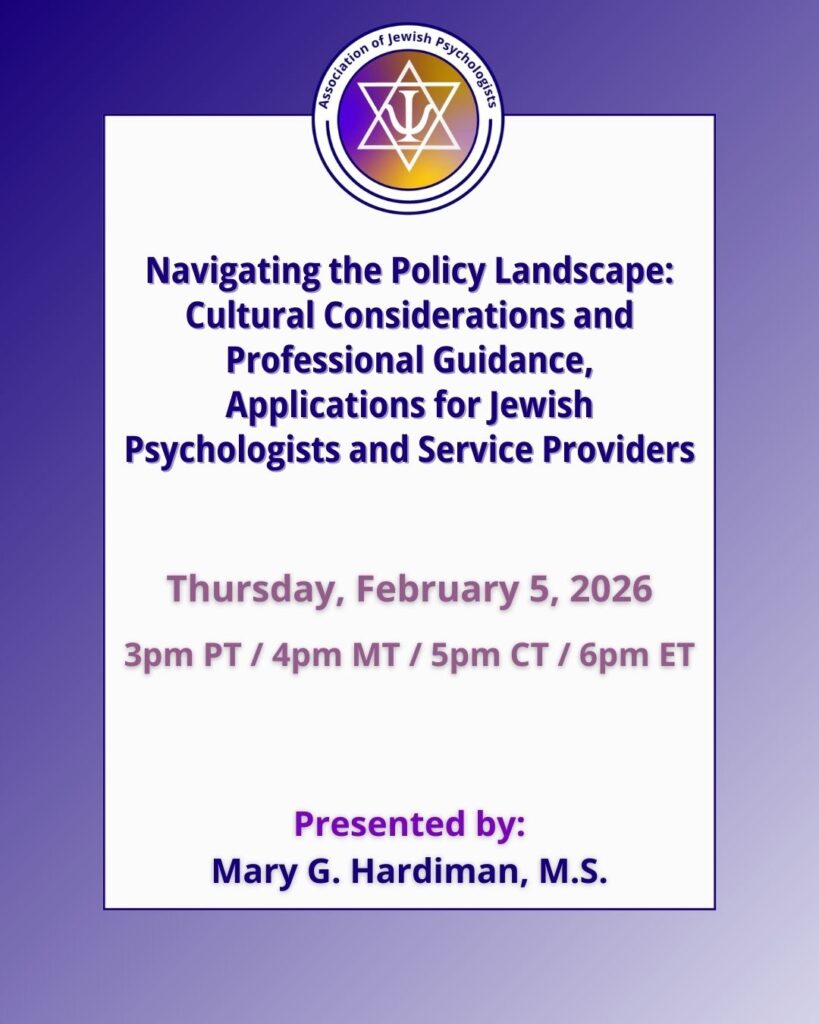
This webinar is presented by Mary G. Hardiman, M.S.
Date: Thursday, February 5, 2026
Time: 3 pm PT / 4 pm MT / 5 pm CT / 6 pm ET
Webinar length is approx 90 mins, ZOOM link will be sent in a registration confirmation email, and will be emailed directly to you a few days before the event.
This webinar is presented by Mary G. Hardiman, M.S. and will include invited guests and group discussion. Among those who will find these sessions of interest are Jewish scientists and practitioners, students, educators, trainers, early career and seasoned psychologists and mental health professionals, Jewish psychologists and allies, and those applying psychological science in health, non-health, and applied areas. Also, those who want a deeper understanding of policy and ways to engage proactively to ensure positive outcomes for the communities they serve and the professionals within these areas and systems.
Policy and professional ethics serve as foundational frameworks that govern how professionals operate, what services they provide, and the settings in which they work. This introductory 1.5-hour webinar, the first in a three-part series, will provide a conceptual overview of the policy-making ecosystem, from institutional to international levels. Using real-world examples and facilitated discussion (including issues of identity, trauma, resilience, and antisemitism), participants will explore the relevance and importance of policy, professional standards, and guidelines, including where policies and other frameworks may be evolved to address key issues. This session will highlight how professionals can effectively engage in these processes, understand the role of professional judgment when policy and other guidance are insufficient, and how these frameworks influence daily practice. Special focus will be given to challenges and opportunities in Jewish psychology.
Intended outcomes include generating ideas for needed professional resources and empowering attendees to navigate and influence the policy landscape in health, non-health, and applied practice settings. This may include promoting the authentic inclusion of Jewish people as a marginalized ethnic, religious, and multiracial people in human rights, diversity, and other policy frameworks.
LEARNING OBJECTIVES: Upon completion of this webinar, participants will be able to:
- Identify the primary venues (institutional, system-wide, state, national, international) where policies that affect professional practice are created.
- Evaluate the interplay between professional ethics, established guidelines, standards, and professional judgment in complex real-world scenarios.
- Analyze how emerging issues in Jewish psychology (e.g., antisemitism, trauma-informed care) are addressed—or potentially fall short—within existing professional guidance products.
- Develop initial strategies for effective professional engagement in policy-making processes within their respective fields.
- Strengthen ways to promote the psychological health and wellbeing of Jewish individuals and communities and other marginalized communities through policy applications and engagement.

Mary G. Hardiman, M.S., is a Washington, D.C. based consultant and governance expert with decades of leadership in nonprofit strategy, policy development, and organizational transformation. She currently provides strategic insights and practical solutions to organizations seeking to strengthen democratic principles, governance structures, ethical frameworks, and member engagement. Previously, she served for 18 years at the American Psychological Association, most recently as Director of Practice Governance and Policy, where she advanced professional policies and standards and coordinated guideline-making activities.
In her prior career, Hardiman had a 3-decade career in the labor movement, most recently as a Director overseeing education and training for a 1.5 million–member organization in the U.S. and Canada. Her multi-faceted career reflects a proven record of accomplishment in advancing collaborations, continuous quality improvement, and conflict resolution, complemented by teaching, guest lecturing, and public speaking at academic institutions and labor studies programs, as well as performing research, writing, and editorial work, and objective reviews for various governmental agencies and nonprofits.
A board member of the Association of Jewish Psychologists, she is recognized for her expertise in policy development, member engagement, and nonprofit governance. Hardiman holds a B.S. in Foreign Service from Georgetown University and an M.S. in Conflict Analysis and Resolution from George Mason University, along with advanced training in nonprofit leadership, policy, social justice, and governance.
Navigating the Policy Landscape
"*" indicates required fields
