

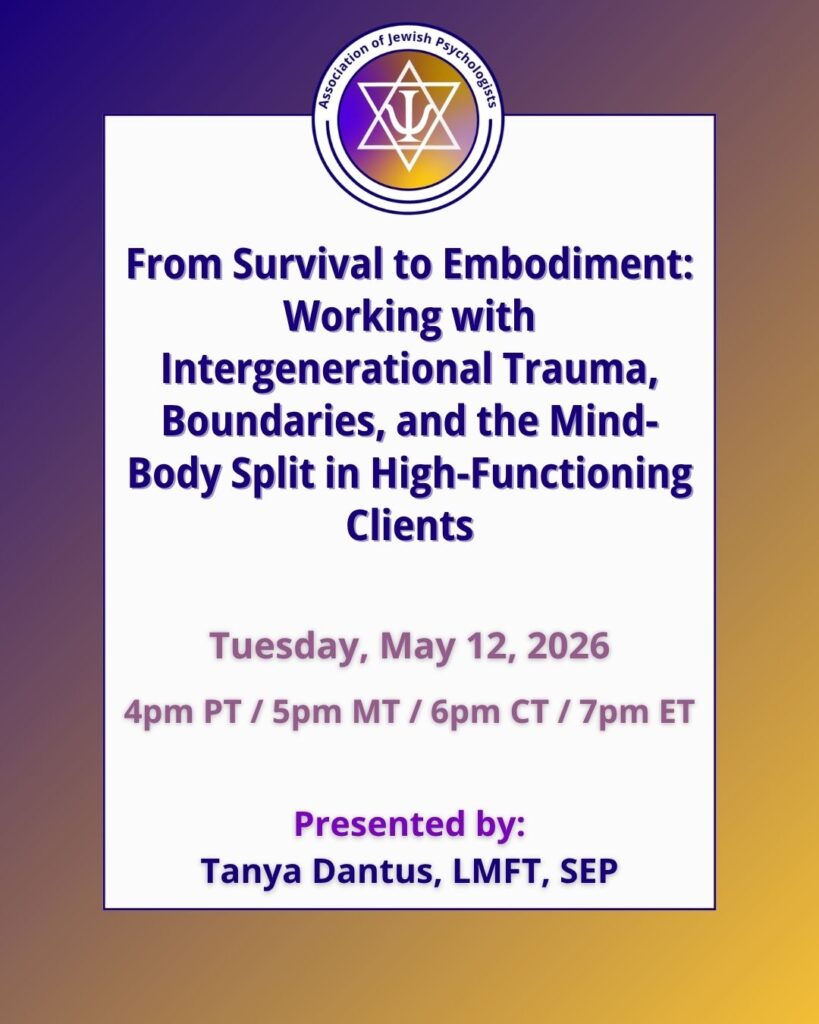
This webinar is presented by Tanya Dantus, LMFT, SEP
Date: Tuesday, May 12, 2026
Time: 4am PT / 5am MT / 6am CT / 7pm ET
Webinar length is approx 90 mins, ZOOM link will be sent in a registration confirmation email, and will be emailed directly to you a few days before the event.
Many high-functioning clients present as capable, insightful, and outwardly successful, yet struggle with chronic patterns of overfunctioning, people-pleasing, and internal disconnection. These patterns are often rooted not only in attachment dynamics but also in intergenerational trauma and culturally shaped adaptations around responsibility, achievement, and belonging.
This webinar offers a somatic and relational framework for understanding how these patterns develop and persist, including the role of intellectualization as both a strength and a protective strategy. Participants will explore how to support clients in moving from insight alone toward embodied awareness, boundary-setting, and more integrated ways of relating.
Learning Objectives:
- Identify how intergenerational trauma and cultural context contribute to patterns of overfunctioning and disconnection in high-functioning clients.
- Understand the role of intellectualization and cognitive strength as adaptive strategies that may also reinforce mind-body disconnection.
- Apply somatic and relational interventions to support clients in developing embodied awareness and more effective boundaries.
- Differentiate between insight-based and embodied change, and integrate both into clinical practice.
 Tanya Dantus, LMFT, SEP, is a licensed psychotherapist, Somatic Experiencing Practitioner, and author of The Power of No: Reclaiming Safety, Boundaries, and Your Voice Through the RIFRA Method. Her work integrates somatic, relational, and depth-oriented approaches to support high-functioning individuals in moving beyond patterns of overfunctioning, people-pleasing, and internal disconnection.
Tanya has worked internationally and specializes in complex attachment dynamics, intergenerational trauma, and identity-related experiences. Her approach bridges insight with embodied change, emphasizing the role of the nervous system in creating lasting transformation. She is particularly interested in how cultural and intergenerational contexts shape patterns of responsibility, belonging, and self-expression.
She is the creator of the RIFRA Method (Root–Impact–Feel–Reflect–Act), a framework designed to translate psychological insight into lived, relational change. In addition to her clinical work, Tanya leads workshops and groups focused on boundaries, embodiment, and relational healing.
From Survival to Embodiment: Working with Intergenerational Trauma, Boundaries, and the Mind-Body Split in High-Functioning Clients
"*" indicates required fields
