

Association of Jewish Psychologists
Comments by Sarah L. Friedman, Ph.D.*
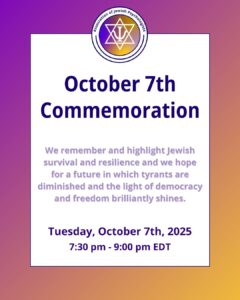
October 7, 2023, shook the world of Israelis and of the Jewish community across the world. We are too close to what transpired to know the long-term effects of the barbaric crimes against Israelis and Israel. But now it is already clear that when the wounds heal, life will be different for Jews in Israel, for the Jews in the diaspora and for the geographic neighborhood of the Middle East.
I was born in Tel Aviv before the creation of the State of Israel. Throughout my childhood and youth, I lived in a community exposed to military conflict and to terrorist activities. When I was in my early teens, I joined a tour of Masada in the Judean Desert, overlooking the western shore of the Dead Sea. Two of our guides were murdered during this trip. Because the frequency of terrorist activities and of war was low, the general sense was that we were safe and that, in general, life was good. Families were generally close knit; social life was rich. For children and youth, school, youth movement, trips within Israel and abroad, and military service were generally fun. Families felt secure and believed that their government, even though not perfect, would protect them. In parallel, over time, the Israeli society that was built on Zionist and socialist ideals became more focused on personal achievement and accumulation of wealth. The grandchildren and great grandchildren of the idealistic founders grew to be self-centered and emulated the lifestyle of their age group in the US. What I just told you, is drawn in very broad-brush strokes but, I believe it is valid.
In March of 2025, I visited Israel for two weeks. The focus of my visit was the week long AJP Mission to Israel to meet with mental health professionals. A few days before and following this Mission trip, I met with my Israeli family and friends. I want to tell you some things I learned.
First and foremost, despite the enormity of the tragedy of October 7, Israelis relied on their well-practiced method of dealing with adversity: That is, they returned as soon as possible to the routines of everyday life. On the surface, life in Tel Aviv, Haifa and Jerusalem appeared completely normal. As vibrant as always. The streets, the shopping malls and coffee shops were very busy. The train I rode from Haifa via Tel Aviv to Jerusalem was as crowded as ever.
The generation of the great grandchildren of the idealists who came to rebuild their ancestral land, who before October 7, seemed to take the existence of Israel for granted, following October 7 proved to be as idealistic and as heroic as their great grandparents. Israelis, qualified to be members of the military reserves, living in Israel or abroad did not wait to be called for military duty. They went to the locations of their units and served. Members of my generation told me how proud they were of the younger generations, the generations that will lead the country to a better future.
But it was not only the soldiers who rose to the occasion. Members of the Israeli society from all walks of life organized and sprang into action. The fact that the Government was caught unaware of the October 7 attack and was not in a position to provide help in a timely fashion to the direct victims of the October 7 attacks, their families and the Israeli society at large, led to the creation of non-governmental groups that took on responsibilities for supporting stressed military units, soldiers and civilians. In addition, civilians of all ages organized a protest movement aimed at pressuring the Government to bring the hostages home and end the ongoing war that saps the energy of the Israeli society and negatively affects its mental health.
And in the Jewish diaspora, Jewish people whose connection with their Jewish identity was weak were awakened to their Judaism as they realized the unprecedented support for the annihilation of Israel, as expressed by what we now know to be a small yet very active segment of society.
Let’s continue to commemorate October 7, a turning point in the history of the Jewish people.
Am Israel Chai.
*Sarah Landau Friedman is a developmental psychologist and Research Professor at the George Washington University Department of Psychological and Brain Sciences. At AJP, she is a member of the Executive Committee and Chairperson of the Research Group. She is also Past President of APA’s Division of General Psychology and Interdisciplinary Inquiry and currently in her third term as a member of the APA Council, where she serves as co-chair of its science caucus.
