

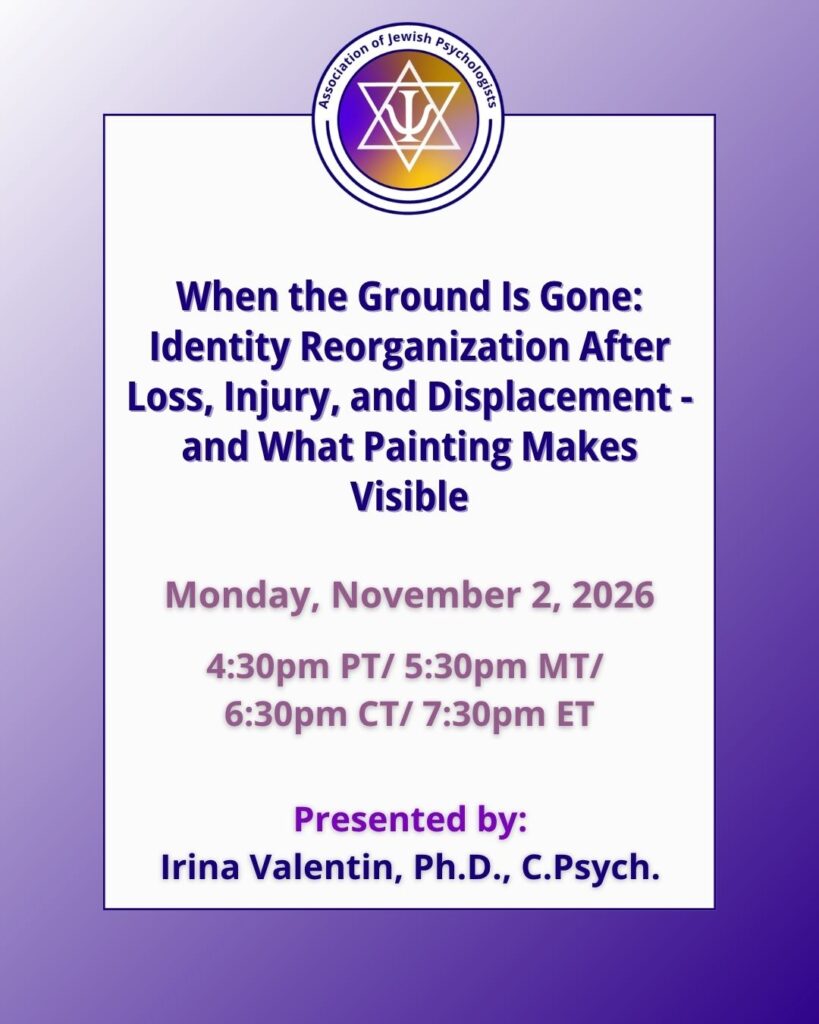
This webinar is presented by Irina Valentin, Ph.D., C.Psych.
Date: Monday, November 2, 2026
Time: 4:30 pm PT/ 5:30 pm MT/ 6:30 pm CT/ 7:30 pm ET
Webinar length is approx. 90 mins. The ZOOM link will be sent in a registration confirmation email and will be emailed directly to you a few days before the event.
Clinicians regularly meet people who, after illness, injury, bereavement, or forced migration, retain their values, memories, relationships and abilities — and still say they have lost themselves. In this webinar, Dr. Irina Valentin begins with clinical material from neuropsychological practice to show why the contents of identity can remain intact while the person no longer recognizes themselves. She introduces identity as an organization nested across self, significant others, and the collective, and distinguishes coherence from viability: an identity may remain entirely consistent and yet become impossible to live under changed conditions.
Painting enters as a way of seeing this process. The presenter shows her own work made in response to the war in Ukraine, then describes a structured method she developed for working with emotion through image, and what practitioners have made within it. The session turns to the collective level, where Jewish experience offers a sustained account of identity persisting when its material conditions are removed, and considers what that may offer communities facing displacement now. Participants will leave with a framework for locating where identity reorganization has stalled and what it requires to continue.
Learning Objectives
By the end of this webinar, participants will be able to:
- Distinguish the contents of identity from its organization, and explain why major life events can leave contents intact while disrupting the experienced sense of self.
- Describe identity as nested across self, other, and collective levels, and trace how change at one level propagates to the others.
- Differentiate coherence from viability in clinical presentations, and recognize when an identity remains consistent but is no longer livable.
- Consider how image-making can make emotional and identity processes visible, and how a structured approach to working with image differs from expressive art activity.
 Irina Valentin, Ph.D., C.Psych., is a clinical neuropsychologist in Toronto, registered in clinical psychology, clinical neuropsychology and school psychology, and Director of Valentin Psychology Professional Corporation. She is the founder of KINERGIA International Institute of Resilience and Human Development and holds an academic appointment at Vinnytsia National Pirogov Memorial Medical University in Ukraine.
Her work concerns how identity reorganizes after trauma and profound change, and appears in Integrative Psychological and Behavioral Science and Existential Analysis. Since 2022 she has taught more than 400 Ukrainian mental health professionals in trauma diagnostics and her own method for working with emotion through image.
She is also an elected member of the Society of Canadian Artists. Painting is not separate from her clinical work but continuous with it, and her paintings inform the theory she develops.
Click here to see Dr. Valentin's online fine art gallery.
Selected References
Presenter’s own work
Valentin, I. (2026). Symbolic acceleration and embodied integration. Integrative Psychological and Behavioral Science. https://doi.org/10.1007/s12124-026-10008-1
Valentin, I. (2026). Stability, oscillation, and relational polarity: On ontological transformation after trauma. Existential Analysis, 37(2), 286–300.
Valentin, I. (2026). Identity after brain injury. OBIA Review, 33(2), 38.
Identity theory
Erikson, E. H. (1968). Identity: Youth and crisis. Norton.
Brewer, M. B., & Gardner, W. (1996). Who is this “we”? Levels of collective identity and self representations. Journal of Personality and Social Psychology, 71(1), 83–93.
McAdams, D. P., & McLean, K. C. (2013). Narrative identity. Current Directions in Psychological Science, 22(3), 233–238.
Campbell, J. D., Trapnell, P. D., Heine, S. J., Katz, I. M., Lavallee, L. F., & Lehman, D. R. (1996). Self-concept clarity: Measurement, personality correlates, and cultural boundaries. Journal of Personality and Social Psychology, 70(1), 141–156.
Iyer, A., Jetten, J., Tsivrikos, D., Postmes, T., & Haslam, S. A. (2009). The more (and the more compatible) the merrier: Multiple group memberships and identity management strategies. British Journal of Social Psychology, 48(4), 707–733.
Disruption and loss of self
Bury, M. (1982). Chronic illness as biographical disruption. Sociology of Health & Illness, 4(2), 167–182.
Charmaz, K. (1983). Loss of self: A fundamental form of suffering in the chronically ill. Sociology of Health & Illness, 5(2), 168–195.
Mitchell, L. L., Frazier, P. A., & Sayer, N. A. (2020). Identity disruption and its association with mental health among veterans with reintegration difficulty. Developmental Psychology, 56(11), 2152–2166. https://doi.org/10.1037/dev0001106
Displacement
Papadopoulos, R. K. (2021). Involuntary dislocation: Home, trauma, resilience, and adversity-activated development. Routledge.
Alayarian, A. (Ed.). Resilience, suffering and creativity: The work of the Refugee Therapy Centre. Routledge.
Art and psychological process
Kaimal, G., Ray, K., & Muniz, J. (2016). Reduction of cortisol levels and participants’ responses following art making. Art Therapy, 33(2), 74–80. https://doi.org/10.1080/07421656.2016.1166832
Viability and meaning
Di Paolo, E. A. (2005). Autopoiesis, adaptivity, teleology, agency. Phenomenology and the Cognitive Sciences, 4(4), 429–452.
Frankl, V. E. (2006). Man’s search for meaning. Beacon Press. (Original work published 1946)
When the Ground Is Gone: Identity Reorganization After Loss, Injury, and Displacement - and What Painting Makes Visible
"*" indicates required fields
